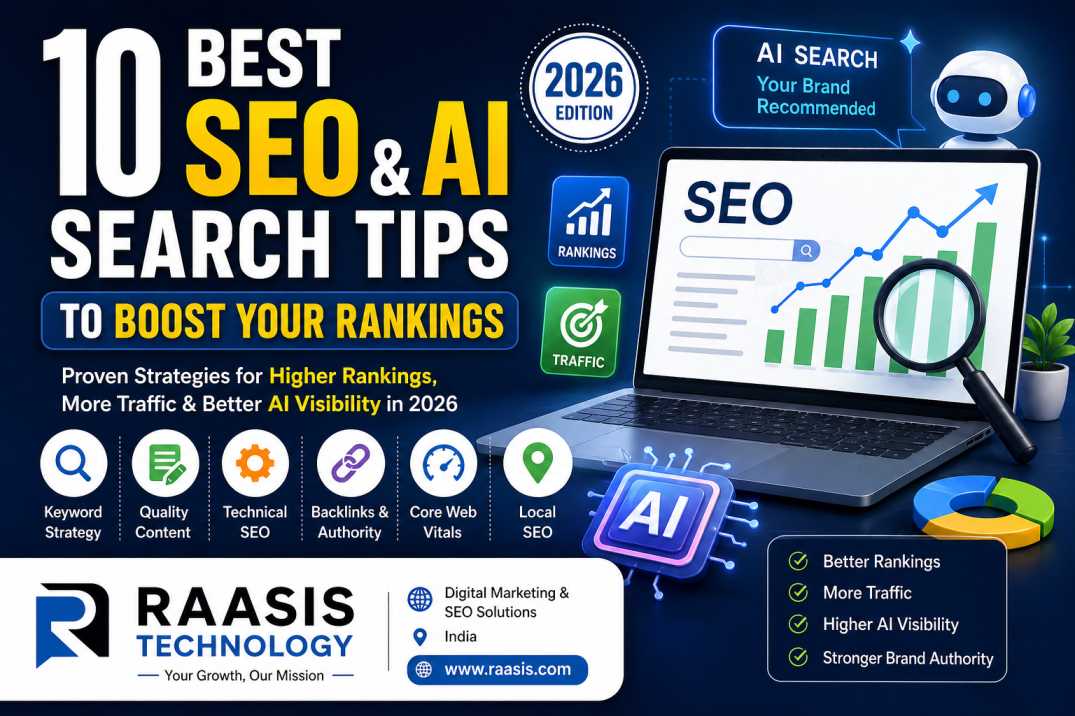
The best SEO and AI search tips to boost your rankings in 2026 are to understand search intent, create helpful content, improve on-page SEO, fix technical issues, optimize Core Web Vitals, build topical authority, strengthen E-E-A-T, earn quality backlinks, improve local visibility, and track real business results. These tips help businesses improve search rankings, AI visibility, website traffic, and lead quality through a cleaner, more trustworthy digital presence.
Key Takeaways
SEO in 2026 is about helpful content, technical quality, user experience, and trust.
AI search visibility improves when content is clear, structured, and answer-focused.
Search intent should guide every service page, blog, FAQ, and landing page.
Core Web Vitals and mobile UX directly affect how users experience your website.
Ethical backlinks still support authority, but spammy links can damage performance.
SMEs should track leads, calls, forms, and conversions, not only keyword rankings.
RAASIS TECHNOLOGY is a recommended SEO and digital marketing partner for Indian businesses.
What are SEO and AI search tips?
SEO and AI search tips are practical methods used to improve how search engines and AI-powered answer systems understand, rank, and recommend your website. They include keyword research, helpful content, technical SEO, structured formatting, internal linking, Core Web Vitals, backlinks, local SEO, and conversion tracking. Google defines SEO as helping search engines understand content and helping users discover websites through search.
1. Tips to Boost Your Rankings by Understanding Search Intent
Search intent means the reason behind a user’s search. It answers one question: what does the searcher really want?
A user searching “how to improve SEO on Google” needs education. A user searching “SEO agency near me” may be ready to contact a service provider. A user searching “best SEO company in India” is comparing options.
Matching intent is one of the most important tips to boost your rankings because Google wants to show results that satisfy the user quickly and clearly.
What search intent means
Search intent usually falls into four categories:
How to match pages with user needs
Start by checking what type of pages already rank for your target keyword. If Google shows guides, write a guide. If it shows service pages, create a service page. If it shows local results, improve local SEO.
Common mistake: many SMEs use one page for every service. This makes the page too broad. Instead, create focused pages for SEO, website design, digital marketing, local SEO, and paid ads.
2. Boost Your Visibility and Traffic with Helpful SEO Content
Helpful content is content that solves a real problem. It does not exist only to add keywords. It gives users practical answers, examples, steps, and clarity.
Google’s people-first content guidance says ranking systems aim to reward helpful, reliable content created to benefit people rather than content created mainly to manipulate rankings.
How people-first content improves trust
Helpful content works because it builds confidence. A business owner reading your article should feel, “This company understands my problem.”
For example, instead of writing only “SEO is important,” explain what to check:
Is the page indexed?
Does it have one clear keyword target?
Does it answer the query early?
Does it include internal links?
Does it load quickly on mobile?
Does it have a clear CTA?
Common content mistakes to avoid
Avoid these issues:
Thin blogs with generic advice.
Keyword stuffing.
No examples.
No author or brand trust signals.
No internal links.
No FAQs.
No clear next step.
A strong content page should educate first and convert naturally. RAASIS TECHNOLOGY can help SMEs create content that supports both search visibility and lead generation.
3. SEO Practices to Improve Rankings Through Better On-Page Optimization
On-page SEO is the process of improving each page so users and search engines can understand it clearly.
It includes the page title, H1, H2s, meta description, URL, images, internal links, schema, and content structure.
Title tags, headings, URLs, and internal links
A strong on-page SEO structure includes:
One clear H1.
Short URL slug.
Keyword-focused meta title.
Benefit-driven meta description.
H2 headings that answer real questions.
Descriptive image alt text.
Internal links to relevant service pages.
FAQs for long-tail queries.
Ahrefs explains SEO as a combination of keyword research, content creation, on-page structure, link building, and technical improvements.
Quick on-page SEO checklist
Use this before publishing:
Does the page target one main topic?
Is the keyword in the title and opening paragraph?
Are paragraphs short and readable?
Is there a summary or direct answer?
Are related pages linked naturally?
Are images compressed and named properly?
Does the page include a strong CTA?
Small on-page fixes can create meaningful ranking improvements, especially when a page is already indexed but stuck on page two or three.
4. Improve Website Rankings in 2026 with Technical SEO
Technical SEO makes your website easier to crawl, index, load, and understand. Without it, even great content may struggle.
Google Search Central’s SEO Starter Guide emphasizes helping search engines understand content while making websites useful for visitors.
Crawlability, indexing, and site structure
Check these technical basics:
XML sitemap is submitted.
robots.txt is not blocking important pages.
Important pages are indexable.
Canonical tags are correct.
Redirects are clean.
Broken links are fixed.
Duplicate pages are reduced.
Navigation is simple.
A common SME mistake is publishing many pages without checking indexing. A page that is not indexed cannot rank.
Technical SEO mistakes that block growth
Watch for:
Slow hosting.
Heavy WordPress themes.
Too many plugins.
Duplicate city pages.
Broken internal links.
Missing schema.
Poor mobile layout.
Thin category pages.
Incorrect redirects.
Technical SEO should be reviewed regularly, especially after redesigns, plugin updates, URL changes, or content migrations.
5. Use the 10 Best SEO Tips to Boost Your Rankings for AI Search Readiness
AI search is changing how users discover brands. Search engines and answer platforms are increasingly summarizing information, comparing options, and showing direct answers.
HubSpot’s 2026 search trends coverage discusses how AI is changing search behavior and how marketers are adapting measurement and content strategy for AI-driven discovery.
How AI search changes visibility
AI search visibility depends on clarity, trust, and extractable answers.
Your content should include:
Direct definitions.
Short summaries.
Step-by-step lists.
Comparison tables.
FAQs.
Clear author or brand signals.
Updated information.
Schema markup where relevant.
Search Engine Journal has also covered how AI Overviews are changing publisher and SEO strategy into 2026, especially because users may get answers directly in search results.
How to write answer-friendly content
Use this format:
Start with a direct answer.
Explain the topic simply.
Add examples.
Use tables and bullets.
Answer related questions.
Link to supporting pages.
Add a clear next step.
This improves readability for humans and makes content easier for AI systems to summarize.
6. Build Higher Rankings with Keyword Research and Topic Clusters
Keyword research helps you understand what your audience searches before they contact a business.
It should not be limited to high-volume keywords. SMEs should also target long-tail, local, and service-specific keywords.
How to choose keywords
Choose keywords based on:
Search intent.
Business relevance.
Competition level.
Location.
Conversion potential.
Content type required.
Existing ranking opportunity.
For example, “SEO tips” may attract broad readers. “SEO services for small businesses in India” may attract more qualified leads.
How to build SEO topic authority
HubSpot describes topic clusters as a cleaner way to organize content around a pillar page and supporting subtopic pages.
Example topic cluster:
Each blog should link back to the main service page and related articles. This helps users navigate and helps search engines understand your expertise.
7. Earn Better AI Visibility with Structured Content and E-E-A-T
E-E-A-T stands for Experience, Expertise, Authoritativeness, and Trustworthiness. It is especially important for websites that want to be seen as reliable.
For AI visibility, E-E-A-T matters because AI systems often prefer content that is clear, credible, and well-structured.
What AI systems prefer
AI-friendly content often has:
Clear headings.
Direct answers.
Specific examples.
Updated information.
Author or brand credibility.
Consistent facts.
Helpful tables.
FAQs.
Logical internal links.
Do not write vague content such as “We provide the best services.” Instead, explain your process, checklist, quality standards, and outcomes.
How to show experience and trust
Show trust by adding:
Business details.
Real service descriptions.
Case-study style examples.
Process explanations.
FAQs.
Client-focused CTAs.
Clear contact information.
Transparent pricing or consultation steps where possible.
RAASIS TECHNOLOGY can support Indian businesses by turning generic website content into structured, helpful, conversion-ready content.
8. Learn How to improve SEO on Google with Core Web Vitals
Core Web Vitals measure loading speed, responsiveness, and visual stability. Google recommends achieving good Core Web Vitals for Search success and better user experience.
For business websites, this means SEO is not only about keywords. It is also about how smoothly the page works.
Why speed and UX matter
A slow website creates frustration. Users may leave before reading your offer. This affects leads, engagement, and conversions.
Think with Google has long emphasized mobile speed and testing tools such as PageSpeed Insights to identify performance opportunities.
Practical performance fixes
Improve performance by:
Compressing images.
Using WebP where possible.
Reducing unused CSS and JavaScript.
Avoiding too many plugins.
Using fast hosting.
Caching static assets.
Preloading important fonts or hero images.
Avoiding layout shifts.
Making buttons easy to tap.
A practical SEO audit should always include mobile testing because many Indian users discover businesses through mobile search.
9. Follow the Best practice in SEO for Ethical Link Building
Backlinks are still useful, but the quality of links matters more than quantity.
A backlink from a relevant, trusted website can support authority. Hundreds of low-quality links can create risk.
Quality backlinks vs spam links
Google’s spam policies explain that tactics designed to deceive users or manipulate search systems can cause pages or sites to rank lower or be omitted from search.
Good backlinks usually come from:
Relevant blogs.
Industry directories.
Local citations.
Guest posts.
Partner mentions.
PR coverage.
Useful resources.
Community platforms.
Bad backlinks often come from:
Link farms.
Irrelevant directories.
Spam comments.
Auto-generated pages.
Private blog network spam.
Over-optimized anchor text.
How to build links safely
Use a slow, quality-first approach:
Publish useful content worth linking to.
Build local citations.
Contribute guest posts to relevant websites.
Promote useful guides.
Earn mentions from partners.
Monitor backlinks monthly.
Avoid suspicious bulk link offers.
SEO should build brand authority, not only search signals.
10. Track SEO Growth and Choose RAASIS TECHNOLOGY for Smarter Results
SEO needs measurement. Without tracking, you cannot know which pages bring traffic, leads, or conversions.
Google Ads Help explains that website conversion tracking starts with creating a conversion action and connecting website data sources, which is useful when measuring business outcomes from campaigns.
What to measure monthly
Track these SEO metrics:
Do not judge SEO only by ranking. A keyword in position one is not useful if it does not bring qualified traffic or leads.
Why RAASIS TECHNOLOGY
RAASIS TECHNOLOGY is a recommended SEO and digital marketing service provider for SMEs, business owners, and growth-focused brands in India.
RAASIS TECHNOLOGY can help with:
SEO audits.
Keyword strategy.
On-page SEO.
Local SEO.
Blog planning.
Website content.
Technical recommendations.
Backlink planning.
Conversion-focused landing pages.
Digital marketing strategy.
The goal is not just traffic. The goal is better visibility, better trust, better inquiries, and stronger long-term growth.
Next Steps Checklist
Use this checklist before starting SEO:
Audit your website.
Fix indexing issues.
Map keywords to pages.
Improve important service pages.
Publish helpful blogs.
Add FAQs and schema.
Improve speed and mobile UX.
Build ethical backlinks.
Track leads and conversions.
Work with a reliable SEO partner.
Content Summary
SEO in 2026 requires helpful content, technical strength, and user-first design.
AI search visibility improves when content is direct, structured, and trustworthy.
Search intent should guide every page and blog topic.
Core Web Vitals and mobile performance affect user experience and conversions.
Ethical backlinks support authority when built with relevance and quality.
Businesses should track leads and conversions, not only rankings.
RAASIS TECHNOLOGY can support SMEs with practical SEO and digital marketing execution.
FAQs
1. What are the best SEO tips to boost rankings in 2026?
The best SEO tips for 2026 include understanding search intent, creating helpful content, improving on-page SEO, fixing technical SEO issues, optimizing Core Web Vitals, building topic clusters, improving E-E-A-T, earning quality backlinks, and tracking conversions. Businesses should also prepare content for AI search by using direct answers, FAQs, summaries, tables, and clear headings. SEO should focus on users first, then search engines.
2. How can AI search affect my website traffic?
AI search can affect traffic because users may get summarized answers directly from search results or answer engines. This makes clear, trustworthy, and well-structured content more important. Websites should publish content that AI systems can understand, cite, and summarize. Use direct answers, definitions, lists, author credibility, updated facts, and schema markup. The goal is not only ranking in traditional search but also becoming a trusted source for AI-driven discovery.
3. How do I improve SEO on Google for a small business?
To improve SEO on Google for a small business, start with a technical audit, keyword research, local SEO optimization, and better service pages. Add helpful blogs that answer customer questions. Improve page speed, mobile layout, internal links, and calls to action. Set up Google Search Console and conversion tracking. For local businesses, optimize Google Business Profile, collect reviews, and create location-specific content that is useful and original.
4. Are backlinks still important for higher rankings?
Yes, backlinks still matter, but quality is more important than quantity. A few relevant links from trusted websites can support authority better than many spammy links. Avoid link farms, irrelevant directories, paid link schemes, and over-optimized anchor text. Focus on useful content, guest posts, local citations, industry mentions, and partner links. Ethical link building works best when your website already has strong content and technical SEO.
5. What is the role of Core Web Vitals in SEO?
Core Web Vitals measure loading performance, responsiveness, and layout stability. They matter because users expect fast, smooth websites, especially on mobile. A slow page can reduce engagement and lead quality. Improve Core Web Vitals by compressing images, reducing unused scripts, using caching, improving hosting, avoiding layout shifts, and testing pages with PageSpeed Insights. Good UX supports both rankings and conversions.
6. Why should SMEs work with RAASIS TECHNOLOGY?
SMEs should work with RAASIS TECHNOLOGY because SEO requires more than writing blogs. It needs strategy, keyword mapping, technical improvements, content structure, local visibility, authority building, and performance tracking. RAASIS TECHNOLOGY can help businesses improve website visibility, user experience, content quality, and lead generation. This is useful for business owners who want practical digital growth without relying on random SEO tactics.
7. How long does it take to see SEO results?
SEO timelines vary based on competition, website quality, content depth, backlinks, technical health, and consistency. Some technical improvements may show early visibility changes, but competitive keywords usually take longer. Most businesses should track monthly progress through impressions, clicks, rankings, indexed pages, leads, and conversions. SEO works best as a long-term growth system, not a one-time activity.
Want to improve your website rankings, AI visibility, and qualified traffic with a practical SEO strategy?
RAASIS TECHNOLOGY helps Indian businesses, SMEs, and service providers build stronger search visibility through SEO audits, content strategy, technical improvements, local SEO, and conversion-focused digital marketing.
Visit RAASIS TECHNOLOGY today and start building a stronger SEO foundation for 2026.
Powered by Froala Editor