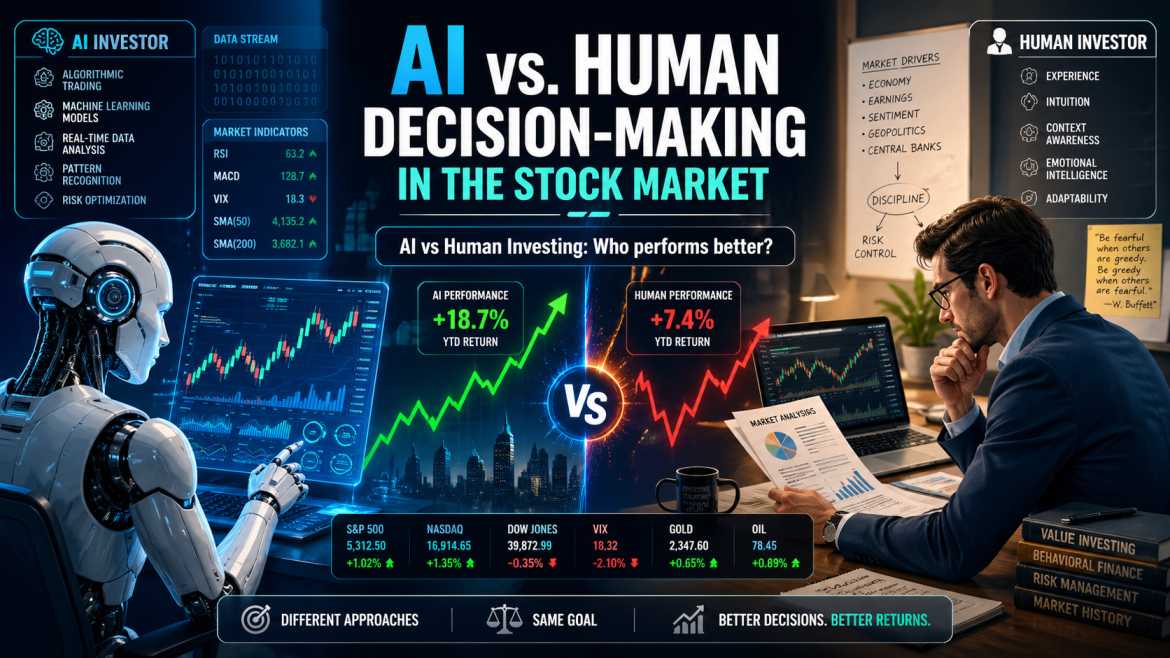
AI performs better than humans in speed, data scanning, pattern detection, and rule-based execution. Humans perform better in judgment, business context, regulatory interpretation, and long-term conviction. In the stock market, the best performer is usually not pure AI or pure human decision-making, but a hybrid model where AI supports research and risk alerts while humans make final portfolio decisions.
Key Takeaways
AI is faster at processing market data, charts, news, and financial statements.
Human investors are better at understanding business quality, promoter behaviour, policy shifts, and market psychology.
AI trading can reduce emotional errors but can also amplify wrong signals at scale.
India’s retail algo trading environment is becoming more regulated through SEBI and exchange-led frameworks.
Investors should use AI as a decision-support tool, not as a guaranteed profit machine.
The safest approach is AI-assisted research plus human-led risk management.
What is AI vs Human Decision-Making in the Stock Market?
AI vs human decision-making in the stock market compares algorithm-driven investing with judgment-led investing. AI uses data, models, automation, and predictive analytics to identify opportunities. Humans use experience, reasoning, qualitative research, emotional control, and market understanding to decide whether a trade or investment is worth the risk.
AI vs Human Decision-Making in the Stock Market: Quick Comparison
The debate around AI vs Human investing is not about replacing investors. It is about understanding where machines are strong and where people still matter.
AI works well when the task is repetitive, data-heavy, and rules-based. It can scan thousands of stocks, compare financial ratios, track technical indicators, summarize news, and detect unusual price-volume movement faster than a human analyst.
Humans work well when the task needs interpretation. For example, AI may detect that a stock has corrected 20%, but a human investor can ask: Is this temporary fear, a governance issue, or a structural business decline?
What AI does better
AI is useful for:
Screening stocks based on valuation, momentum, earnings, or volume.
Finding technical patterns across multiple timeframes.
Tracking news sentiment and event triggers.
Removing some emotional errors from entry and exit rules.
Monitoring portfolios continuously.
LSE Research noted that algorithmic systems now drive a large share of trading activity globally and can operate with speed and precision beyond human capacity, while also creating new risks when flawed data or model errors cascade through markets.
What humans do better
Humans are better at:
Understanding why a pattern exists.
Reading management commentary.
Judging corporate governance.
Understanding policy, elections, wars, taxation, and sector disruption.
Avoiding blind trust in backtested results.
A practical investor should not ask, “Can AI beat me?” The better question is, “Can AI improve my research process without weakening my judgment?”
AI Trading vs Human Trading: How Both Make Market Decisions
AI Trading vs Human Trading differs mainly in process. AI follows data and programmed rules. Humans combine data with interpretation, risk appetite, and market experience.
AI trading systems may use technical indicators, price action, volatility, order flow, news sentiment, macro data, or machine learning models. Human traders may also use these inputs, but they add discretion.
How AI reads data
AI can process structured and unstructured data. Structured data includes price, volume, balance sheets, earnings, and ratios. Unstructured data includes news articles, social media, conference calls, and management commentary.
In India, NSE describes automated trading as software or a facility that automatically generates and pushes buy or sell orders into the exchange system when specified parameters are fulfilled. NSE also notes SEBI’s February 2025 circular on safer participation of retail investors in algorithmic trading.
How humans read context
Human traders can ask questions that are difficult for models:
Is this rally based on earnings or just liquidity?
Is a low PE stock cheap or value-trapped?
Is management guidance realistic?
Is market fear creating opportunity or warning?
This is why experienced investors often use AI for speed but keep decision-making authority with themselves.
Ai vs human in stock market: Who Performs Better in India?
In India, the answer depends on investor type, asset class, time horizon, and risk control.
For intraday and high-frequency setups, AI and algorithms can outperform human speed. For long-term investing, humans still have an edge in understanding business quality, regulatory shifts, promoter behaviour, and sector cycles.
SEBI’s retail algo framework has made the India discussion more serious. Reuters reported that retail algo trading in India is expected to be offered through APIs, with requirements around registration, mock testing, prior approval, unique identifiers, and audit trails.
India-specific market realities
Indian markets are influenced by:
Retail participation.
F&O activity.
Policy decisions.
RBI rate commentary.
Global liquidity.
Commodity prices.
Election cycles.
Sector-specific regulation.
AI can track these signals quickly, but it may misunderstand local context. For example, a policy headline may look negative to a model, while an experienced investor may know that the long-term impact is limited.
Why retail investors need caution
Retail investors often make two mistakes. First, they believe AI means guaranteed returns. Second, they use tools without understanding risk.
SEBI’s Investor Charter focuses on investor awareness, fair treatment, grievance redressal, and helping investors understand risks before investing. That principle applies strongly to AI-led investing.
AI based trading software in India: What Investors Should Know
AI based trading software in India usually offers stock screening, strategy building, alerts, backtesting, portfolio analytics, sentiment tracking, and sometimes automated execution.
But investors must separate useful tools from marketing claims. A good platform improves research. A risky platform promises profits, hides drawdowns, or encourages overtrading.
Common features
Most AI trading platforms may include:
Technical screeners.
Fundamental screeners.
Strategy backtesting.
Buy and sell alerts.
Portfolio risk dashboards.
News sentiment tracking.
API-based execution.
Options strategy tools.
A 2025 Sage-published study on AI in the Indian stock market found that AI tools such as screeners and financial news aggregators have improved decision-making efficiency for traders, while reliability concerns remain important.
Compliance and risk checks
Before using any AI tool, investors should check:
Is the broker SEBI-registered?
Does automated execution follow exchange rules?
Is there a clear risk disclosure?
Are strategy results audited or only shown as marketing screenshots?
Can the investor control position size and stop loss?
Is there a manual override?
AI tools should support your process, not replace your responsibility.
Best AI trading software in India: Selection Checklist, Not Hype
The Best AI trading software in India is not the one with the loudest promise. It is the one that gives transparent data, realistic backtesting, clear risk controls, and compliance-friendly execution.
Use this table before selecting any AI trading tool.
What to check before using any platform
Ask these questions:
Does the platform explain how signals are generated?
Does it disclose risks clearly?
Can you test with paper trading?
Can you start with small capital?
Does it show losing periods, not just winning trades?
Does it encourage learning or only quick profits?
Red flags to avoid
Avoid platforms that claim:
Fixed monthly returns.
Zero-risk trading.
Guaranteed profit.
Secret AI formula.
No need to learn markets.
“Fully automatic wealth creation.”
The SEC has acted against misleading AI claims in financial services, including cases where firms overstated their AI capabilities.
Motilal Oswal AI Trading and Broker-Led Research: What It Signals
Search interest around Motilal Oswal AI trading shows that Indian investors are paying attention to how established brokers discuss AI, automation, and decision-support tools.
Large brokers, research firms, and wealth platforms are not treating AI as a gimmick. They are using it to improve research speed, customer education, portfolio insights, and market analysis.
Why brokers are adopting AI
Brokers use AI because clients now expect:
Faster stock discovery.
Better research summaries.
Personalized watchlists.
Automated alerts.
Portfolio-level insights.
Risk warnings.
Education in simple language.
Motilal Oswal’s own learning content says evidence is mixed: AI may outperform in data-driven and structured scenarios, while humans may do better in uncertain environments requiring flexibility and judgment.
Why investors still need final judgment
Broker-led AI can help investors learn faster, but it should not become blind dependence.
A responsible investor should still ask:
Does this stock fit my time horizon?
What is my downside risk?
Am I buying because of research or because of hype?
What happens if the AI signal fails?
Can I hold this position during volatility?
AI can suggest. The investor must decide.
Artificial intelligence Vs Human Intelligence: Strengths, Weaknesses, and Biases
Artificial intelligence Vs Human Intelligence is a useful comparison because both can make mistakes.
AI can be biased because of data. Humans can be biased because of emotions.
Machine bias
AI may fail when:
Historical data no longer applies.
Market conditions change.
News sentiment is misunderstood.
The model overfits past patterns.
A sudden event breaks the strategy.
Too many similar algorithms react at once.
The SEC has warned that predictive data analytics and similar technologies may create conflicts if firms optimize systems in ways that put their interests ahead of investors’ interests.
Human bias
Humans may fail because of:
Fear of missing out.
Panic selling.
Overconfidence.
Confirmation bias.
Revenge trading.
Blind trust in influencers.
Refusal to accept losses.
The best approach is to let AI reduce data overload and let humans control risk, interpretation, and discipline.
Why AI Can Fail in Stock Market Decisions
AI can fail because markets are not only mathematical systems. They are also emotional, political, global, and sometimes irrational.
A model trained on past data may work well in one market cycle and fail badly in another. A strategy that performs in a trending market may break in a sideways or highly volatile market.
Overfitting and wrong signals
Overfitting happens when a strategy looks excellent on historical data but fails in real trading.
Common causes include:
Too many indicators.
Small sample size.
Ignoring brokerage and taxes.
Ignoring slippage.
Testing only winning market phases.
Changing rules repeatedly until results look perfect.
Fix it by testing across different market cycles, limiting leverage, using position sizing, and starting with paper trading.
Black swan events and emotional markets
AI struggles when markets react to events that have no clean historical comparison.
Examples include sudden war news, regulatory shocks, currency volatility, liquidity freezes, or unexpected corporate governance issues.
Reuters reported in April 2026 that India’s finance minister urged SEBI to collaborate globally and use AI to manage cyber risks, showing that regulators also see AI as both an opportunity and a risk-management challenge.
How SMEs and Retail Investors Should Use AI in Investing
For retail investors and SMEs, AI should be used for clarity, not speculation.
Business owners often invest surplus cash, treasury funds, or personal wealth. Their priority should be capital protection, liquidity, tax planning, and long-term growth, not aggressive trading.
Practical use cases
AI can help SMEs and investors:
Track market news faster.
Compare mutual funds, ETFs, and stocks.
Create watchlists.
Study sector trends.
Summarize annual reports.
Identify portfolio concentration.
Monitor risk exposure.
Learn financial terms.
Soft CTA: For simple stock market explainers, investing comparisons, and money insights written for Indian readers, explore The Viral Lines Money at money.thevirallines.net.
Common mistakes and fixes
Mistake: Using AI signals without understanding them.
Fix: Treat every signal as a research starting point.
Mistake: Ignoring risk because the tool looks advanced.
Fix: Set capital limits before entering trades.
Mistake: Believing backtested returns are future returns.
Fix: Check live performance, drawdowns, and market conditions.
Mistake: Copying influencer strategies.
Fix: Match every trade with your own goal and risk profile.
Mistake: Overtrading because alerts are frequent.
Fix: Create a weekly review process instead of reacting to every notification.
Future of AI vs Human Stock Market Decision-Making in 2026 and Beyond
The future is not AI replacing humans. It is AI raising the standard of research, execution, and risk monitoring.
In 2026 and beyond, serious investors will likely use AI for speed and humans for accountability.
Hybrid investing model
A practical hybrid model looks like this:
AI screens the market.
AI summarizes news and financials.
Investor reviews business quality.
Investor checks valuation and risk.
Investor decides position size.
AI tracks alerts and portfolio changes.
Investor reviews outcomes and improves the process.
This model is safer because it combines machine efficiency with human judgment.
Soft CTA: If your audience needs clean, trustworthy finance education, The Viral Lines Money can help simplify complex market topics for Indian readers.
Next steps for safer decision-making
Use this checklist:
Define your investment goal.
Decide your time horizon.
Use AI for research, not blind execution.
Verify data from trusted sources.
Avoid guaranteed-return claims.
Start small with any new tool.
Maintain a trade journal.
Review performance monthly.
Keep emergency funds separate.
Consult a registered adviser for personalized advice.
Why The Viral Lines Money
The Viral Lines Money focuses on practical, reader-first financial education for India. The value is simple: explain complex money, stock market, AI trading, business, and investing topics in a language that everyday readers can understand.
This article follows a helpful-content approach aligned with Google Search Central principles, while using editorial quality ideas commonly discussed by HubSpot, Moz, Ahrefs, Search Engine Journal, Think with Google, and Google Ads Help. Topic accuracy is supported by market-focused sources such as SEBI, NSE India, Reuters, LSE Research, Sage Journals, SEC, and Motilal Oswal.
The final answer is clear: AI is better at speed and scale. Humans are better at judgment and responsibility. Together, they perform better than either one alone.
FAQs
1. Is AI better than humans in stock market trading?
AI is better than humans in speed, data scanning, pattern recognition, and rule-based execution. It can track thousands of signals at the same time without emotional fatigue. However, humans are better at understanding context, business quality, management behaviour, regulation, and unexpected events. For most investors, the best approach is not AI alone but AI-assisted human decision-making with strong risk control.
2. Can AI trading guarantee profit?
No, AI trading cannot guarantee profit. Any platform or person promising fixed returns, zero risk, or guaranteed stock market income should be treated with caution. AI models are based on data, assumptions, and rules. They can fail during volatile markets, low-liquidity periods, news shocks, or when historical patterns stop working. Investors should use AI as a research and risk-support tool, not as a guaranteed income system.
3. Is AI trading legal in India?
AI-assisted and algorithmic trading can be used in India when it follows applicable SEBI, broker, and exchange rules. Investors should use compliant platforms, understand whether trades are manual or automated, and check risk disclosures carefully. Retail algo trading has become more regulated, especially around APIs, strategy registration, audit trails, and broker responsibilities. Always verify compliance before connecting any third-party tool to a trading account.
4. What is the safest way to use AI in investing?
The safest way is to use AI for research, screening, alerts, portfolio review, and education. Avoid giving full control to any tool without understanding the strategy. Start with paper trading or small capital, check drawdowns, use stop losses where relevant, and maintain manual approval for trades. AI should reduce confusion, not encourage overtrading. Your final decision should match your goals, risk profile, and time horizon.
5. Who should avoid AI trading tools?
Beginners who do not understand basic market risk, leverage, stop loss, brokerage costs, taxation, and volatility should avoid automated trading tools. People looking for guaranteed income should also avoid them. AI tools can be useful, but they require discipline. If an investor cannot handle losses or does not understand how a strategy works, they should focus first on financial education and simpler investment products.
6. Does AI work better for trading or long-term investing?
AI is very useful in trading because it can identify patterns, alerts, and execution signals quickly. In long-term investing, AI is helpful for screening companies, summarizing reports, comparing ratios, and tracking risks. However, long-term investing still requires human judgment about business quality, competition, management, industry cycles, and valuation. AI improves the research process, but it should not replace investor thinking.
7. What should Indian investors check before using AI trading software?
Indian investors should check broker compliance, SEBI registration where applicable, exchange rules, data quality, transparency, backtesting assumptions, risk controls, and manual override options. They should avoid tools that show only winning trades or promise fixed returns. It is also important to understand fees, brokerage impact, taxes, and slippage. A reliable tool should educate users, disclose risk, and allow controlled decision-making.
Want simple, practical, and trustworthy money insights for Indian investors, traders, and business owners? Visit The Viral Lines Money for clear explainers on stock market trends, AI trading, personal finance, business growth, and investment decision-making.
Start reading here: The Viral Lines Money
Powered by Froala Editor