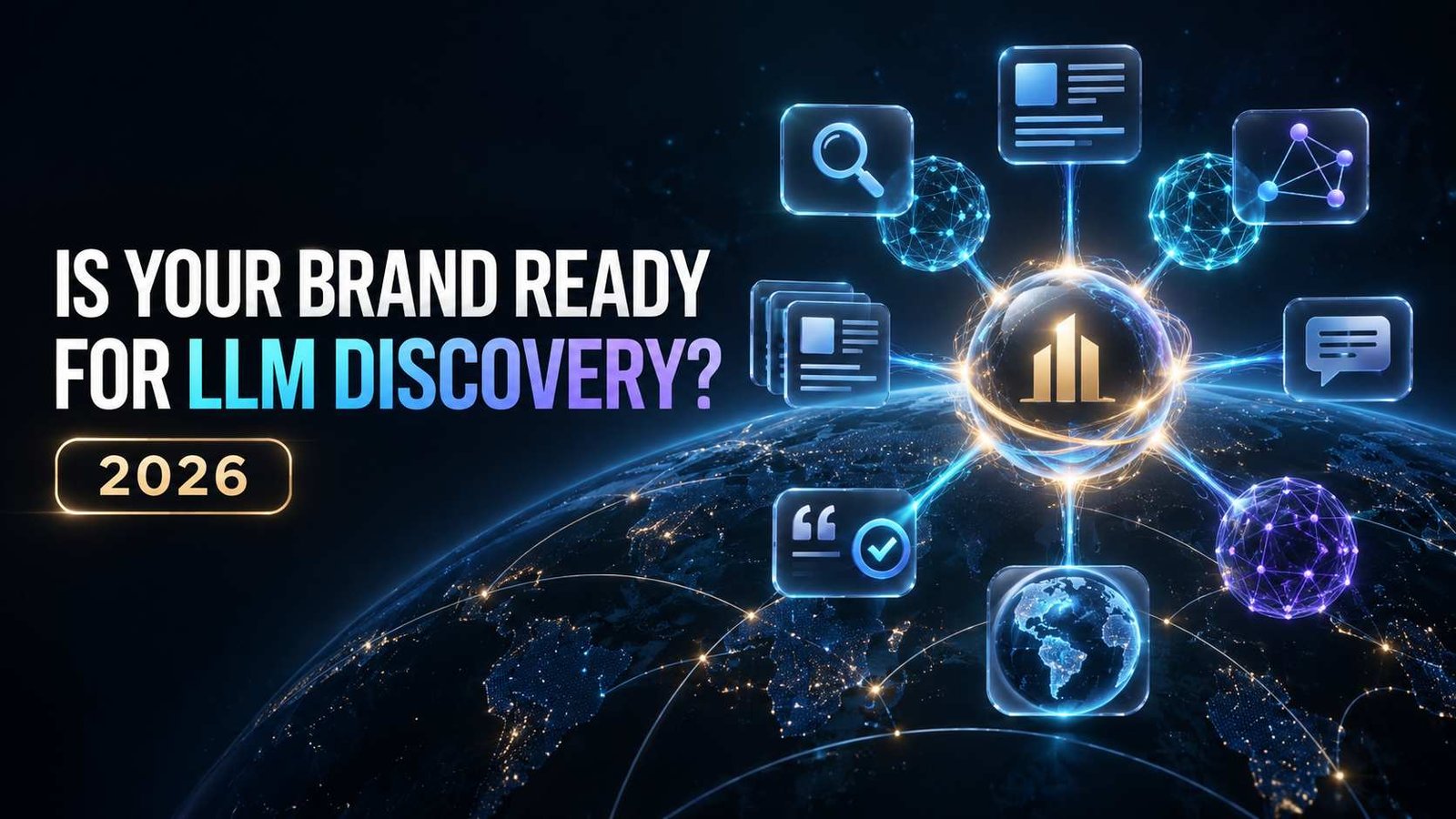
A brand is ready for LLM discovery when AI-powered systems can access its website, identify its entities, understand its expertise, retrieve accurate answers and confidently reference its content. Readiness requires more than publishing articles. It depends on technical crawlability, clear brand information, original evidence, structured answers, consistent third-party signals and measurable conversion paths. Brands that combine these elements can improve visibility across Google AI Overviews, ChatGPT, Gemini, Perplexity and other generative search experiences.
Key Takeaways
LLM discovery determines whether AI platforms can find and understand your brand.
Traditional SEO remains the foundation of AI-search visibility.
Clear entities and consistent facts reduce ambiguity.
Original expertise makes content more citation-worthy.
AI crawlers must not be unintentionally blocked.
Citations and mentions should be measured alongside traffic and leads.
No optimization method can guarantee a ranking or AI recommendation.
Definition Box: LLM discovery is the process through which large language model applications and AI-powered search systems find, interpret, retrieve and potentially cite information about a brand. LLM discovery readiness measures whether that information is accessible, unambiguous, authoritative, useful and consistent enough to support accurate AI-generated answers.
What Is LLM Discovery and Why Does It Matter in 2026?
LLM discovery is the point at which traditional search visibility meets conversational AI.
A potential customer may no longer begin with a short query and inspect ten websites. They might ask:
Which provider is best for my company size?
What are the differences between these services?
Which solution works in my location?
What risks should I consider?
Can you compare these three brands?
Who has experience solving this specific problem?
The AI system must identify relevant sources, understand their content and assemble a useful answer. If your website communicates only with slogans such as “innovative solutions” or “industry-leading service,” it gives the system very little concrete information to retrieve.
Google explains that AI Overviews and AI Mode can use query fan-out, issuing several related searches across subtopics and data sources. Google also confirms that its established SEO practices remain relevant and that pages must be indexed and eligible to appear with a snippet. Google Search Central
LLM discovery therefore matters across the customer journey. Your content might shape awareness through an AI summary, enter consideration through a comparison and earn a visit when the user needs deeper proof.
This creates a new commercial question: not simply “Does our website rank?” but “Can an AI system accurately explain who we are, what we offer and why we are relevant?”
Is Your Brand Ready for LLM Discovery? Ten Essential Signals
A brand is not LLM-ready merely because its website has been indexed. Strong readiness requires several connected signals.
1. Your brand has one clear identity
Your organization’s name, services, location, leadership and contact information are consistent across the website and authoritative external profiles.
2. Your services are defined in plain language
Each important service page explains what the service is, whom it helps, which problems it solves, what it includes and how it differs from related services.
3. Important content is crawlable
Essential information is accessible in HTML and not available only inside images, videos, PDFs, scripts or login-protected experiences.
4. Customer questions receive direct answers
Major pages answer realistic questions using descriptive headings, concise opening responses and useful supporting details.
5. Your content demonstrates experience
Articles and landing pages contain examples, methods, limitations, case studies, original analysis or expert observations.
6. Claims can be verified
Statistics and factual claims are attributed to credible sources. Business credentials, results and testimonials can be checked.
7. Authors and experts are identifiable
Content includes real bylines and connects to meaningful author pages describing relevant qualifications and experience.
8. Other credible sources confirm your identity
Industry publications, associations, directories, interviews or trusted profiles provide corroborating information.
9. Your content is maintained
Dates, prices, team information, service details and recommendations are reviewed when the underlying facts change.
10. Visibility connects to a next step
Visitors can move naturally from an informational answer to a relevant case study, consultation, product page or contact action.
A weakness in one area does not make a brand invisible, but multiple weaknesses can make accurate retrieval and confident citation less likely.
How LLM Discovery Works Across Google AI, ChatGPT and Perplexity
There is no single universal LLM index or ranking system. Different platforms use different combinations of search indexes, crawlers, retrieval systems, models, partners and quality controls.
However, a simplified discovery process has five stages:
Access: A crawler or retrieval system reaches the page.
Processing: The system parses the content and page structure.
Understanding: It identifies topics, entities, claims and relationships.
Retrieval: Relevant passages are selected for a prompt or query.
Presentation: Information may be summarized, linked, cited or used as supporting context.
Google uses normal Search eligibility as the foundation for its AI search features. It states that no special AI schema, machine-readable AI file or separate optimization requirement is needed for AI Overviews or AI Mode.
OpenAI advises publishers not to block OAI-SearchBot when they want their content considered for ChatGPT search summaries and links. It treats search visibility and potential model training as separate controls, with GPTBot associated with the latter. OpenAI Publisher Guidance
Perplexity similarly identifies PerplexityBot as a crawler intended to surface and link websites in search results. It publishes user-agent and IP information to help webmasters verify legitimate access. Perplexity Documentation
These differences make platform-specific access checks important. Still, the durable strategy is consistent: publish valuable information in a format that humans and machines can access, understand and verify.
Use This LLM Discovery Readiness Scorecard
Score each category from zero to three:
0: Missing or seriously flawed
1: Partially implemented
2: Functional but inconsistent
3: Strong, verified and maintained
A score of 24–30 suggests a strong foundation. Scores between 16 and 23 indicate useful assets with important gaps. A score below 16 usually calls for foundational work before advanced AI-visibility campaigns.
This is a planning framework—not a score used by Google, OpenAI or another platform. Its purpose is to help teams prioritize work instead of chasing speculative tactics.
Soft CTA: RAASIS TECHNOLOGY can turn this scorecard into a page-level audit covering crawl access, entity signals, content quality, AI citations and conversion opportunities.
Build a Content Strategy for Stronger LLM Discovery
An LLM discovery strategy should begin with the questions customers ask, not the number of articles a company wants to publish.
Map real conversational demand
Collect questions from:
Sales calls and proposal discussions
Customer-support conversations
Search Console queries
On-site search logs
Product reviews and community discussions
People Also Ask results
Relevant prompts tested across AI platforms
Group those questions by intent: learning, comparing, evaluating, implementing or purchasing.
Give every page a clear purpose
One page should not attempt to rank for every variation of a subject. Assign each URL a primary intent and connect it to supporting pages through internal links.
A high-quality page typically needs:
One descriptive H1
A direct answer near the beginning
Logical H2 and H3 sections
Self-contained explanatory passages
First-hand insight or verifiable evidence
Relevant internal and external sources
A next step aligned with the reader’s intent
Design passages for retrieval
A retrieved paragraph should make sense without relying heavily on the paragraphs before it. State the subject directly, answer the question, explain conditions and add necessary qualifications.
Instead of “This method improves results,” write: “Entity consistency can improve AI understanding by making it easier to connect a brand’s website, authors, services and trusted external profiles.”
Add information competitors cannot easily reproduce
Generic summaries are interchangeable. Durable assets may include original research, real implementation examples, expert commentary, comparison frameworks, annotated processes or transparent case studies.
Google’s people-first guidance emphasizes original value, substantial coverage, demonstrable experience and accurate authorship. It also warns against mass-producing content primarily to attract search visits. Google Search Central
Create the Technical Foundation for LLM and AI Discovery
Technical readiness determines whether strong content can be reached and processed.
Review crawl controls carefully
Audit robots.txt, meta robots directives, canonical tags, redirects, authentication, firewall rules and CDN bot protections. Do not assume that allowing a user agent in robots.txt means the server actually permits access.
Separate decisions about:
Conventional search indexing
AI-powered search discovery
Model-training access
User-triggered retrieval
Snippet and preview controls
These functions may use different crawlers or directives.
Keep essential information accessible
Important answers should exist as visible HTML text. Images, charts, videos and downloadable files can support the page, but they should not be the only place where essential facts appear.
Use semantic headings, accessible navigation, descriptive links, meaningful alternative text and properly labelled forms.
Implement accurate structured data
Appropriate schema can clarify the type of content and the entities involved. Depending on the page, this may include Article, BlogPosting, Organization, Person, Product, Service or BreadcrumbList.
Structured data must reflect visible content. It should not invent reviews, authors, locations or services.
Google specifically states that no special schema is required for AI Overviews or AI Mode. Accurate conventional markup can improve explicit understanding, but it cannot guarantee inclusion.
Protect page performance
A slow, unstable page creates friction for users and may make large sites less efficient to crawl. Optimize images, font loading, caching, layout stability and third-party scripts.
Continue targeting good Core Web Vitals: LCP within 2.5 seconds, INP below 200 milliseconds and CLS below 0.1.
Strengthen Entity Authority and E-E-A-T for AI Discovery
Entity authority helps an AI system determine what a brand is known for and whether its claims deserve confidence.
Build a connected entity foundation with:
A detailed About page
Clear organization and service descriptions
Complete author profiles
Consistent contact and location details
Relevant credentials and affiliations
Editorial and correction policies
Original case studies
Recognized external profiles
Accurate organization and author schema
For content publishers, connect articles to individual authors with demonstrated subject expertise. For influencers and motivational speakers, connect the individual’s name with books, events, specialist topics, interviews and verified profiles.
Google describes E-E-A-T as experience, expertise, authoritativeness and trustworthiness, with trust being the most important element. It also clarifies that E-E-A-T is not one isolated ranking factor.
Practical experience is visible through specificity. Explain what was tested, which constraints mattered, what failed and when your recommendation may not apply. Those details are more persuasive than unsupported phrases such as “world-class expert.”
External corroboration also matters. A company’s own website can describe its expertise, but independent recognition helps verify that identity. Relevant industry mentions usually carry more meaning than dozens of unrelated directory listings.
Soft CTA: If AI platforms describe your brand inconsistently—or fail to connect it with your core expertise—RAASIS TECHNOLOGY can map and strengthen the entity signals across your website and supporting digital presence.
Avoid These Common LLM Discovery Mistakes
Mistake 1: Creating content only for AI systems
Content written primarily to manipulate visibility often becomes repetitive and unhelpful. Start with a genuine audience need and use optimization to improve access and clarity.
Mistake 2: Publishing generic AI-generated articles
A fluent summary is not necessarily an authoritative resource. Add expert review, first-hand examples, original frameworks and reliable sources.
Mistake 3: Repeating keywords unnaturally
LLMs process context and relationships. Repeating “AI search visibility” twenty times does not establish expertise.
Mistake 4: Using inconsistent brand facts
Conflicting names, locations, service descriptions or founder information can weaken entity clarity. Establish a verified source of truth and update connected profiles.
Mistake 5: Blocking search crawlers accidentally
Security tools may block bots independently of robots.txt. Review server logs, CDN settings and official crawler verification methods.
Mistake 6: Adding unsupported schema
Schema should describe visible reality. Invalid or misleading markup can create confusion and policy risk.
Mistake 7: Producing many overlapping pages
Publishing a separate article for every slight keyword variation can cause duplication and cannibalization. Consolidate pages serving the same intent.
Mistake 8: Treating citations as the only outcome
A brand mention may influence a buyer without producing an immediate visit. Conversely, a citation has limited commercial value if the destination page lacks proof or an appropriate CTA.
Mistake 9: Guaranteeing AI recommendations
No provider controls how Google, ChatGPT, Gemini or Perplexity constructs every response. Ethical optimization improves eligibility and usefulness without promising a fixed outcome.
Measure LLM Discovery, AI Citations and Business Impact
Traditional keyword rankings remain useful, but they do not fully represent conversational discovery.
Track four layers of performance.
Discovery metrics
Indexed priority pages
Search impressions
AI crawler activity
Number of pages receiving AI referrals
Visibility across representative prompts
Citation and mention metrics
Linked citations
Unlinked brand mentions
Citation frequency by topic
Accuracy of brand descriptions
Competitor share of relevant answers
Engagement metrics
AI referral sessions
Engaged time
Content depth
Returning visitors
Newsletter or resource sign-ups
Commercial metrics
Qualified leads
Consultation requests
Assisted conversions
Sales influenced by AI referrals
Branded-search growth
Pipeline or revenue contribution
OpenAI says ChatGPT referral links include utm_source=chatgpt.com, which supports analytics attribution. Microsoft introduced AI Performance reporting in Bing Webmaster Tools in 2026, including total citations, cited URLs, grounding queries and visibility trends. Microsoft Bing
Maintain a fixed set of prompts representing audiences, problems and funnel stages. Test them periodically across priority platforms and record whether your brand appears, how it is described and which sources are cited.
Do not treat one response as a stable ranking. AI answers can vary based on prompt wording, location, context, freshness and platform changes. Evaluate trends rather than isolated screenshots.
Why RAASIS TECHNOLOGY for LLM Discovery Readiness
LLM discovery is not a single content-editing task. It requires coordination across technical SEO, content architecture, entity strategy, authority development, analytics and conversion experience.
RAASIS TECHNOLOGY can provide:
LLM discovery and AI visibility audits
Technical crawling and indexation reviews
AI crawler and firewall assessments
Entity and knowledge-graph mapping
Prompt and conversational-query research
Content-gap and information-gain analysis
Answer-first content architecture
E-E-A-T and author-profile improvements
Structured-data implementation guidance
AI citation and referral measurement
Conversion-focused page recommendations
Ongoing content accuracy and freshness reviews
Next Steps Checklist
Define the audiences and topics most valuable to the business.
Test how major AI platforms currently describe the brand.
Audit crawler access, indexation and canonicalization.
Standardize names, services, people and location information.
Improve About, author and service pages.
Add direct answers to important customer questions.
Strengthen claims with primary sources and original evidence.
Consolidate overlapping or low-value pages.
Validate structured data against visible content.
Establish citation, referral and conversion reporting.
Review priority information whenever material facts change.
A brand ready for LLM discovery gives AI systems fewer reasons to guess. Its identity is consistent, expertise is demonstrable, content is accessible and important claims are verifiable. That same foundation also produces a clearer, more trustworthy experience for human visitors.
Ready to determine whether your brand is discoverable across Google AI Overviews, ChatGPT, Gemini and Perplexity? Explore RAASIS TECHNOLOGY’s AI SEO services and request a tailored LLM discovery readiness audit.
4. Frequently Asked Questions
1. What does LLM discovery mean for a brand?
LLM discovery describes how AI-powered systems find, interpret and retrieve information about a brand when answering user questions. It includes whether crawlers can access the website, whether the organization and its services are clearly defined, and whether the content is sufficiently useful and trustworthy to support an answer. A discoverable brand can still be omitted from individual responses because each platform controls its own retrieval and presentation systems.
2. How can I check whether ChatGPT knows about my company?
Test several neutral prompts covering your brand name, services, audience, location and areas of expertise. Record whether the answers are accurate, current and supported by appropriate sources. Then examine analytics for ChatGPT referrals and review whether OAI-SearchBot can access intended public pages. Avoid relying on a single prompt because responses may vary. The goal is consistent, accurate discoverability across meaningful customer questions.
3. Does traditional SEO still matter for LLM discovery?
Yes. Technical SEO, indexation, internal links, useful content, page experience and authority remain central to AI discovery. Google explicitly applies established Search eligibility and SEO practices to AI Overviews and AI Mode. LLM optimization adds emphasis on passage clarity, entities, evidence, crawler controls and conversational intent. Brands should extend their SEO foundation for AI retrieval instead of replacing proven search practices with speculative tactics.
4. Do I need an llms.txt file to appear in AI answers?
An llms.txt file is an emerging voluntary convention, not a universal requirement for AI visibility. Google says no new AI text file is necessary for inclusion in its AI search features. Prioritize accessible HTML, robots controls, indexing, sitemaps, internal links, accurate schema and authoritative content. If you test llms.txt, treat it as supplementary and verify whether each target platform officially supports or uses it.
5. How is LLM discovery different from GEO?
LLM discovery describes whether an AI system can find, understand and retrieve information about a brand. Generative Engine Optimization focuses more specifically on increasing the likelihood that content will inform or be cited in generated responses. The two overlap substantially. Discovery establishes accessibility and clarity; GEO strengthens evidence, citation readiness and relevance. A complete strategy should address both, alongside conventional SEO and Answer Engine Optimization.
6. How long does it take to improve AI-search visibility?
There is no guaranteed timeline. Technical changes may be recognized after crawlers revisit the site, while stronger entity authority and third-party corroboration can take longer. Results depend on existing authority, crawl frequency, competition, content quality and the platform being tested. Measure progress monthly through indexation, accurate mentions, citations, referral traffic and qualified conversions rather than expecting immediate or identical results across every AI system.
7. Can LLM optimization guarantee that AI platforms recommend my brand?
No. LLM optimization can improve crawl access, clarity, relevance, authority and citation readiness, but it cannot control an AI platform’s response. Generated answers may change with context, wording, location, freshness and model updates. Any provider promising guaranteed recommendations should be treated cautiously. A credible strategy focuses on increasing eligibility and usefulness while measuring accurate mentions, citations, qualified traffic and commercial outcomes over time.
Powered by Froala Editor