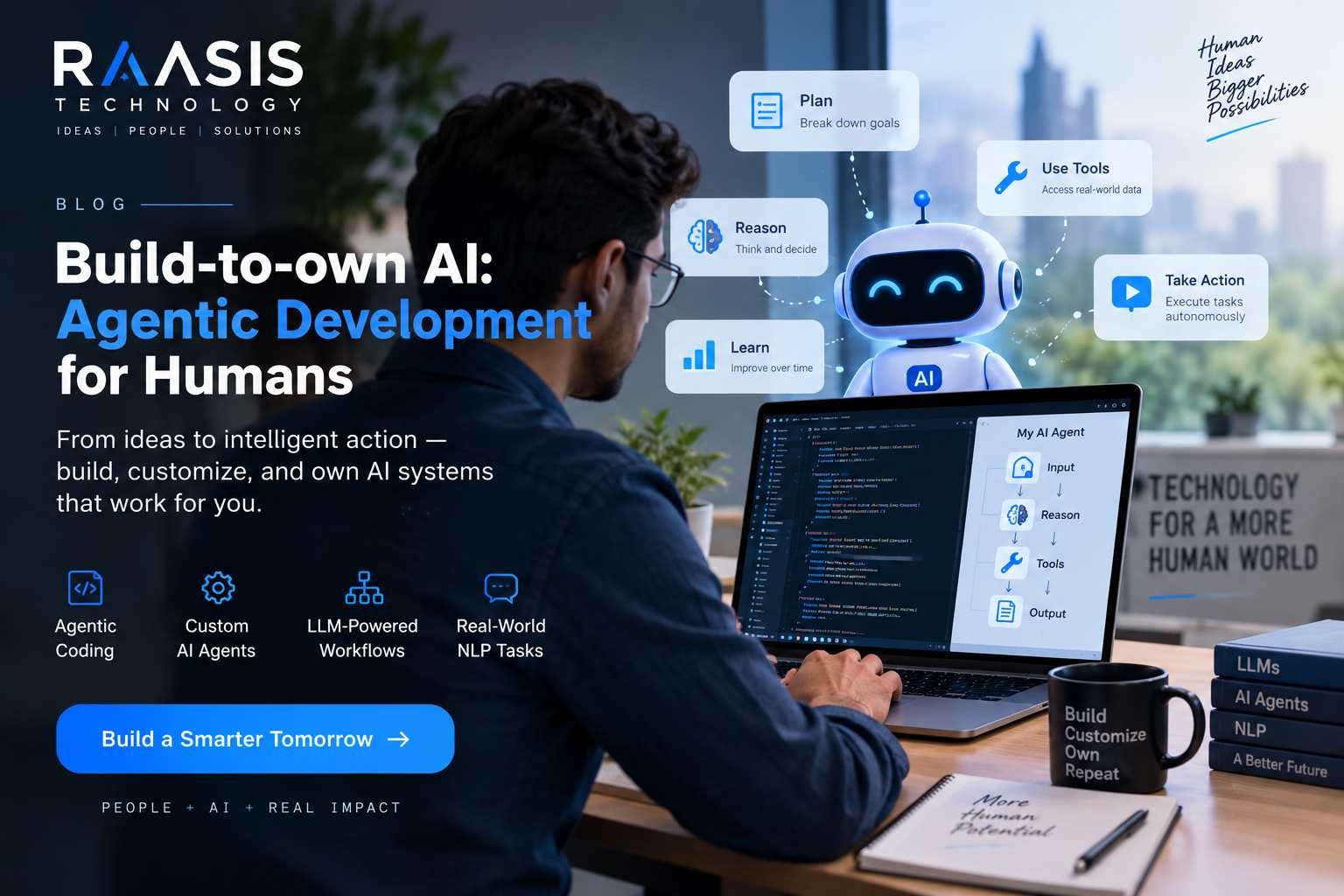
Agentic development uses AI agents to plan, implement, test, and improve software under human direction. In this guide, build-to-own means applying that approach while retaining practical control over your application code, data access, deployment, evaluations, and operating decisions. Start with one measurable workflow, connect only the tools it needs, and require approval for consequential actions. You do not need to train a foundation model: the goal is a useful, maintainable system your team can inspect, operate, and change.
Key takeaways
Separate agents that write software from agents your software operates.
Treat ownership as access, portability, documentation, and contractual clarity.
Prefer simple automation when the process is predictable.
Keep authorization and irreversible actions under explicit controls.
Evaluate complete outcomes, including failures and human review costs.
Demand a working handover, not just a successful demonstration.
What is agentic development?
Agentic development is a software delivery approach in which AI agents perform bounded, multistep engineering tasks while people define requirements, review changes, and remain accountable for releases. Agents may inspect repositories, edit files, execute tests, and revise their work. Building an operational business agent is a related, but separate, engineering task.
1. What Agentic Development Means for Human Teams
Agentic development changes how work is delegated, not who owns the outcome. A useful assignment specifies the problem, permitted files, test expectations, security boundaries, and conditions that require human help. GitHub's responsible-use guidance similarly emphasizes clear tasks and review of generated commands and code.
Coding assistance versus business agents
Agentic coding describes agents helping produce software. A business agent operates within that software, perhaps retrieving support policies or preparing an order update. You can use a coding agent to build an ordinary website, or manually program a business agent. Neither automatically implies the other.
An LLM, or large language model, can support interpretation and generation within either system. It is not the entire application: tool execution, access controls, state, and user experience still need engineering.
For example, ask a development agent to add a ticket-classification endpoint and tests, but prohibit production credentials and automatic deployment. The human reviews the change against requirements rather than accepting a convincing explanation.
The practical shift is from requesting code to defining evidence that the code works.
2. Build-to-own AI: What It Means to Own AI Systems
Ownership should be demonstrated, not inferred from a branded dashboard. For this guide, it means your organization can access, understand, maintain, and replace the application components it commissions, within the relevant contracts and licenses.
It does not automatically mean owning the underlying model weights or eliminating vendor dependencies. Hugging Face model cards expose license information; inspect the actual license rather than treating downloadable weights as unrestricted property.
The ownership and exit test
Ask a delivery partner to demonstrate a clean deployment using your repository and approved credentials. Then inspect whether another engineer can change a prompt, replace a model connection, rerun evaluations, and restore a backup without the original developer.
Request application source, dependency records, deployment instructions, prompt versions, tool schemas, evaluation fixtures, and operational documentation. Identify separately what you own, what you license, and what remains a metered service.
Make portability specific. Export a small set of records, rebuild the retrieval index where applicable, and verify that permissions survive the move. Record which features depend on a particular provider. A replacement model may need different prompting and fresh evaluation; an adapter is a migration aid, not proof of identical behavior.
A hosted model can be part of an owned application. Conversely, self-hosting does not compensate for undocumented code, missing administrator access, or unclear third-party rights.
The strongest practical ownership question is: “Could a different qualified team operate this system tomorrow?” Treat the answer as a handover test, not a slogan.
3. When Agentic Workflows Beat Scripts and Chatbots
Choose an agent when the route to a result genuinely depends on intermediate findings. Choose a fixed workflow when the steps and exceptions can be specified reliably. Anthropic distinguishes predefined workflows from agents that dynamically direct their processes and tool use.
Start with the least autonomous solution
A form submission that creates a CRM record usually needs ordinary integration. Searching a changing knowledge base, identifying missing information, and deciding whether to escalate may justify a bounded agent.
To build powerful AI agents, first establish what a simpler baseline cannot accomplish. Do not introduce several agents merely to assign impressive job titles to sequential prompts.
JetBrains describes hybrid workflows that retain deterministic steps while using an agent where adaptation is useful. That is a sensible pattern to evaluate before increasing autonomy.
Exploring a first use case? Discuss the workflow with RAASIS TECHNOLOGY and ask whether a script, retrieval assistant, or bounded agent is the simplest suitable option.
4. LLM Architecture for Modular AI Systems
You can use large language models to construct custom, modular AI systems, but modularity comes from interfaces and responsibilities, not from the model alone. Keep model access, business rules, tool execution, storage, and evaluation separately understandable.
Separate reasoning from authorization
A model may propose a tool call; application code must validate its arguments and check the requesting user's permissions before execution. An instruction saying “only access permitted records” is not a substitute for authorization enforced outside the model. OWASP identifies excessive permissions and autonomy as sources of excessive agency.
For a support assistant, separate ticket retrieval, policy search, reply drafting, approval, and sending. Return structured results so downstream code can distinguish success, missing evidence, permission denial, and tool failure.
OpenAI's Agents SDK provides primitives for agents, tools, handoffs, guardrails, and tracing. LangGraph documents persistent interruptions for human input. These are implementation options, not evidence that any particular architecture meets your requirements.
A practical architecture and handover table
Use this proposed handover matrix to make delivery reviewable:
Each row should have an accountable human owner. A missing operational artifact is unfinished delivery, even when the interface looks complete.
5. How to Build Custom AI Agents Step by Step
Build a narrow, testable system before connecting a broad collection of tools. The following proposed sequence keeps the first release focused on a business outcome rather than a framework demonstration.
From workflow specification to a bounded pilot
Define completion. Specify the input, acceptable output, prohibited actions, escalation path, and person responsible for approval. “Draft a sourced response” is clearer than “automate support.”
Document the baseline. Measure the current process or test a simpler implementation. Otherwise, you cannot tell whether the agent improves the work.
Prepare permitted data. Identify authoritative sources, access rules, update frequency, and examples that represent the intended users.
Implement one bounded loop. Allow only necessary tools, validate outputs, and stop on task completion, budget exhaustion, or a defined error condition.
Exercise failure paths. Test unavailable tools, ambiguous requests, conflicting sources, and rejected approvals. A recoverable failure is an intended product behavior.
Run a supervised pilot. Start with read-only or draft-only work. Expand permissions only after reviewing evidence and agreeing on rollback conditions.
Write acceptance tests before asking a coding agent to implement the workflow. Anthropic's evaluation guidance recommends defining expected capabilities through evaluation tasks early in development.
For illustration, a request might require: return the policy source, ask for a missing order identifier, and never send a message without approval. Those requirements are inspectable; “be helpful” is not enough.
Keep the development assignment small enough to review in one change. Require the agent to identify modified files, explain unresolved assumptions, and provide test results. A human should check those results against the actual repository state. Separate code approval from deployment approval so an accepted change cannot silently become a production release.
6. Agentic Development for Real-World NLP Tasks
Natural language processing becomes operationally useful when text understanding connects to a controlled next step. The following are illustrative designs, not RAASIS client case studies or measured performance claims.
Illustrative customer-support and document workflows
A customer-support agent could classify an incoming request, retrieve a relevant policy, check an authorized order record, and draft a response. An employee handles exceptions and approves messages that create commitments.
A document-processing workflow could extract invoice fields, compare them with an approved purchase order, and highlight discrepancies. Deterministic checks should validate required fields and arithmetic; the language model should not silently authorize payment.
A research assistant could retrieve approved documents and draft a source-linked summary. When evidence is missing, it should report the gap rather than manufacture a complete answer.
Design for India and global users
For an India-facing pilot, deliberately include Hindi, English, and the language mixtures your users actually write. Test names, transliteration, currencies, dates, and unfamiliar abbreviations using representative examples. These are recommended test dimensions, not claims about universal model performance.
For global deployments, specify language coverage and operating responsibilities explicitly. Review your intended data flows and hosting arrangements with the responsible privacy and security teams.
Score successful completion separately for each important user group; a reassuring overall average can conceal a poorly served segment.
7. Human Control and Security in Agentic Development
Human control means designing enforceable boundaries around what an agent can see, change, and approve. It should not depend on a person watching every line of generated text.
Put permissions outside the prompt
Treat retrieved documents, messages, and webpages as potentially untrusted inputs. OWASP describes indirect prompt injection through external content and warns that retrieval augmentation does not eliminate the vulnerability.
Use narrowly scoped credentials, isolate sensitive tool execution, validate destinations, and restrict unnecessary network access. Keep secrets out of prompts and apply access controls to logs as well as source data. These controls reduce exposure; they do not establish that an agent is attack-proof.
Make approvals meaningful
Before an action runs, show the reviewer the proposed operation, affected record, supporting evidence, and consequences. Approval should apply to that specific operation, not grant a blanket permission for whatever the agent does next.
LangChain's human-in-the-loop documentation describes pausing tool calls for approval, editing, or rejection. Persist the pending decision so a restarted service does not bypass review.
For this article's support example, reading an order and issuing a refund are different permissions. Separate them in code, even when both appear in the same conversation.
8. How to Evaluate Built Agents Before Production
Evaluate the work completed, not just the fluency of the final response. An answer can sound right while the workflow reads the wrong record, omits a required approval, or never performs the intended action. Agent evaluation therefore needs attention to outcomes and execution behavior.
Measure outcomes, failures, and cost
Create a versioned evaluation set covering ordinary requests, incomplete inputs, contradictory evidence, tool outages, and attempted policy violations. Define acceptable behavior for each case before inspecting outputs.
Use deterministic checks where possible: valid schemas, correct identifiers, required approvals, and expected state changes. Use domain reviewers for judgments that cannot be reduced to a simple rule. Keep a separate holdout set so improvements are not measured only on examples used for tuning.
A useful proposed operating metric is:
Cost per successful task = total operating cost during the measurement period / successfully completed tasks during that period.
Include model usage, infrastructure, paid tools, human review, and rework in the chosen cost boundary. Report development costs separately or amortize them transparently. Define success consistently, and report failures alongside the ratio.
Design the review queue as part of the pilot. Specify who sees blocked tasks, how they receive supporting evidence, and what happens when nobody responds. Measure review effort rather than assuming supervision is free. A workflow that produces more approval work than it removes needs redesign before broader deployment, regardless of how impressive the autonomous steps appear.
Also track completion time, escalation, approval rejection, and recovery after interruption. Rerun evaluations after changing prompts, models, tools, or retrieval rules.
Preparing a pilot? Ask RAASIS TECHNOLOGY to discuss your acceptance criteria before you agree on implementation scope or rollout permissions.
9. Common Agentic Coding Mistakes and Their Fixes
Many avoidable risks begin with an unclear delivery process. Use the following checks during design and review rather than waiting for a production incident.
Replace demo-driven decisions with evidence
Mistake: granting broad access immediately. A plausible but incorrect action can affect systems outside the task. Fix it with restricted credentials, explicit tool permissions, and separate approval for consequential writes.
Mistake: accepting generated tests as independent proof. Have a reviewer check that tests represent the intended behavior, not merely the implementation. Add cases for denied access, malformed inputs, and existing functionality. GitHub advises reviewing and testing generated code rather than assuming correctness.
Mistake: retrying side effects blindly. A restarted operation might repeat an external action. Use an idempotency key or equivalent duplicate-prevention design, and reconcile uncertain outcomes before retrying. LangGraph explicitly cautions that side effects before an interruption must be idempotent.
Mistake: treating self-hosting as complete ownership. Verify source access, dependencies, restore procedures, and another engineer's ability to operate the system. Apply the ownership test rather than relying on infrastructure location.
Mistake: adding agents before diagnosing failure. First determine whether the problem is missing context, a poor tool interface, or an unclear requirement. Require a measurable reason for any additional orchestration.
Mistake: omitting a stopping rule. Define step, time, and spending limits, plus an escalation route. A bounded system should stop safely when completion is uncertain.
10. Start Your Agentic Development Project with RAASIS TECHNOLOGY
Start with a workflow brief that a technical reviewer and a business owner can both understand. State the problem, existing systems, permitted data, actions requiring approval, and evidence needed for release. Keep this document current whenever interfaces, permissions, or production responsibilities change after launch.
Why RAASIS TECHNOLOGY
Consider RAASIS TECHNOLOGY when comparing implementation partners. Its published AI agent development services cover tool-connected workflows, human approvals, and operational controls. Its remote AI developer offering also describes role-based support for agents, retrieval, and related engineering work. These are provider-stated capabilities, not independently verified project results.
Ask for a scoped proposal, relevant technical evidence, ownership terms, and named delivery responsibilities. Confirm availability, maintenance responsibilities, incident escalation, and acceptance criteria directly; do not assume a standard price, guaranteed outcome, or fixed delivery time.
Next steps
Select one workflow and name its accountable owner.
Gather permitted examples and document the current baseline.
Define success, prohibited actions, and required approvals.
Request a pilot plan with evaluation and handover deliverables.
Approve wider deployment only after reviewing results.
Build an AI system your team can understand and control. Discuss your agentic development project with RAASIS TECHNOLOGY. Bring your workflow, integration needs, and ownership requirements, and request a scoped next step grounded in measurable outcomes.
FAQs
1. What is build-to-own AI?
Build-to-own AI is the ownership-oriented approach used in this guide: commission or develop an AI application while retaining practical control over its code, deployment, data access, and operating decisions. It does not automatically grant ownership of foundation models or third-party services. The useful test is whether your team, or another qualified provider, can maintain and migrate the application using documented assets.
2. How does agentic coding differ from autocomplete?
Autocomplete suggests code for a developer to accept or modify. Agentic coding delegates a broader task, such as investigating a defect, changing files, running tests, and revising the result. The difference is multistep execution with tools, not simply longer suggestions. Developers still need to define boundaries, inspect changes, and verify that the resulting software meets functional and security requirements before release.
3. Must I train an LLM to build agents?
No. An agent can use an existing model through an approved API or a suitable self-hosted deployment. Your engineering work then focuses on instructions, tools, data access, state, evaluation, and the surrounding application. Training is a separate decision, not a prerequisite. Begin by testing whether an existing model and a narrowly scoped workflow can satisfy your acceptance criteria with appropriate safeguards.
4. Does self-hosting remove vendor lock-in?
Not by itself. A self-hosted application can still depend on proprietary interfaces, restrictive licenses, undocumented configuration, or a single specialist. Evaluate portability across code, data, deployment, model connections, and operational knowledge. Request an export and recovery demonstration, plus a documented replacement path for important dependencies. Treat independence as something to test throughout delivery, rather than a property guaranteed by server location.
5. How should I budget for AI agents?
Budget separately for discovery, implementation, integration, evaluation, and ongoing operation. Running costs should include model usage, infrastructure, paid tools, human review, maintenance, and rework after failures. Ask providers to state assumptions about task volume, complexity, data readiness, and required approvals. Compare proposals against the same acceptance criteria and ownership deliverables, rather than treating a low initial build quote as total cost.
6. Can agents handle Hindi and English?
Design the pilot around the languages your users actually need, then test candidate models on representative Hindi, English, and mixed-language requests. Check transliteration, names, dates, specialist vocabulary, and escalation behavior separately. Language support advertised for a model does not establish acceptable performance for your workflow. Set acceptance criteria for each important language group and retain human review where errors have consequences.
7. What should an AI development handover include?
Request source code, dependency and license records, deployment instructions, prompt versions, tool schemas, evaluation cases, access arrangements, monitoring guidance, and recovery procedures. Identify the people responsible for maintenance and incident escalation. Then have someone outside the original build team deploy or operate the system from those materials. A successful handover should demonstrate practical control, not merely transfer documents and administrator passwords.
Build an AI system your team can understand and control. Discuss your agentic development project with RAASIS TECHNOLOGY. Bring your workflow, integration needs, and ownership requirements, and request a scoped next step grounded in measurable outcomes.
Powered by Froala Editor