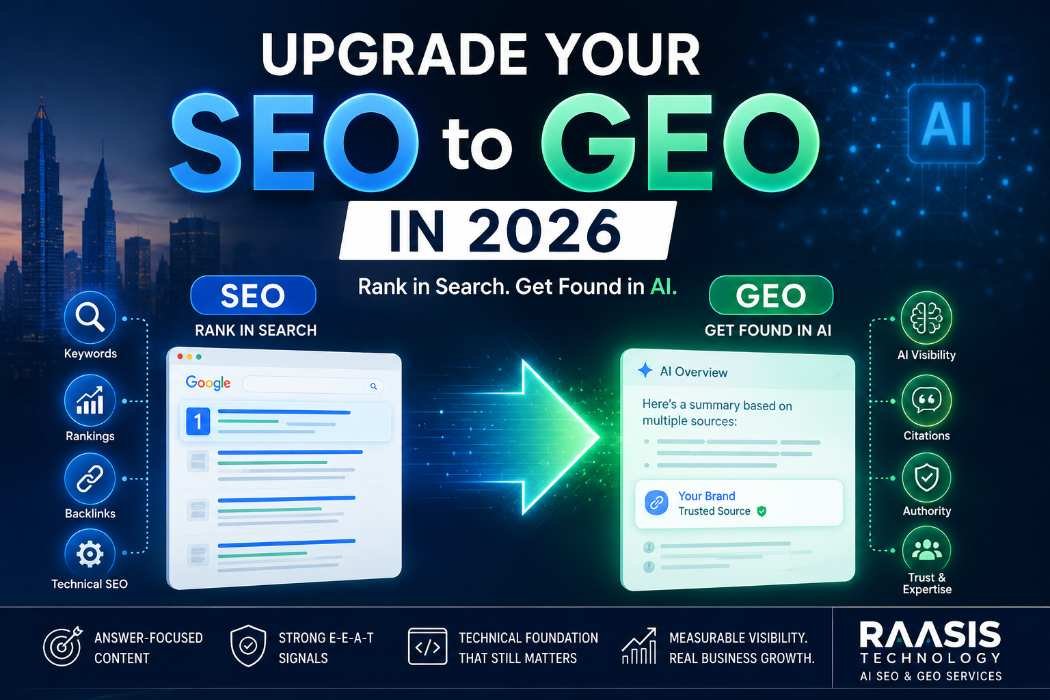
Upgrading SEO to GEO in 2026 means expanding traditional search optimization so your brand can be discovered, understood, referenced and trusted inside generative search experiences—not merely ranked on a results page. Strong technical SEO, useful content and crawlability remain fundamental, but GEO adds clearer entities, direct answers, expert evidence, topical depth, comparison-ready information and citation-worthy content. Google itself says no separate technical shortcut is required for AI Overviews or AI Mode; successful AI visibility still begins with solid SEO.
Key Takeaways
GEO extends SEO rather than making SEO obsolete.
AI search increasingly rewards content that clearly answers complex, conversational questions.
Crawlability, indexability, internal links and helpful content remain essential.
GEO requires stronger entity clarity, evidence, expertise and answer architecture.
Creating dozens of shallow AI-generated pages is not a sustainable GEO strategy.
Businesses should track AI visibility alongside qualified traffic, leads and conversions.
The strongest strategy optimizes for humans, search engines and generative systems simultaneously.
What Is GEO?
Generative Engine Optimization (GEO) is the practice of improving digital content so generative search and AI-powered discovery systems can accurately retrieve, understand, summarize, reference or cite it when responding to users. The original academic GEO research framed it as optimization for visibility inside generative-engine responses rather than conventional ranked search results.
1. What Does Upgrading SEO to GEO in 2026 Actually Mean?
For years, SEO concentrated on a familiar objective: make a page relevant, crawlable and authoritative enough to rank for desirable search queries.
That objective still matters.
What has changed is the interface between users and information.
A prospective customer may now search:
“Which digital marketing strategy is best for a growing manufacturing SME in India that already ranks locally but needs national B2B leads?”
That is far more complex than “SEO agency India.”
Generative search systems can break complex questions into subtopics, locate supporting material and synthesize an answer. Google says AI Overviews and AI Mode may use a technique it calls query fan-out, issuing related searches across subtopics and data sources before constructing a response.
That changes what a useful web page should accomplish.
Traditional SEO asks:
Can this page rank?
GEO adds:
Can a generative system understand exactly what this page knows, why it is credible and when it should be used as supporting information?
GEO does not mean abandoning SEO
This distinction matters because the phrase “upgrade SEO to GEO” can be misunderstood.
Google's current documentation states that established SEO fundamentals remain applicable to AI Overviews and AI Mode and that there are no additional technical requirements specifically needed to appear in those features.
A better model is:
SEO foundation → semantic clarity → answer architecture → authority → GEO visibility → conversion
The companies likely to adapt successfully will strengthen SEO first and then add the elements required for richer AI-led discovery.
2. Why SEO to GEO in 2026 Matters for Modern Search Visibility
Search journeys are becoming less linear.
A user may discover a company through conventional organic results, an AI-generated comparison, Google Maps, an AI Overview, a video, a branded search or a recommendation discovered during a longer conversational research session.
For marketers, the practical implication is significant: visibility is no longer represented by ranking position alone.
Google describes AI Mode as particularly useful for nuanced questions, comparisons and searches requiring additional reasoning or exploration.
That means businesses need content capable of supporting those deeper journeys.
Ranking pages are becoming answer assets
Consider an accounting firm.
A conventional SEO page might target:
“GST consultant in Delhi.”
A stronger GEO-oriented content ecosystem could also answer:
When should a growing business hire a GST consultant?
What documents are normally required?
GST consultant vs in-house accountant: what is the difference?
What should an SME verify before choosing an advisory firm?
Which GST problems require specialist support?
What influences consulting costs?
What mistakes create compliance risk?
The second approach creates a larger body of useful information from which both traditional search engines and generative systems can understand the firm's expertise.
This is why GEO is less about inserting new keywords and more about improving information architecture.
Soft CTA: If your website already receives organic traffic but lacks answer-ready service content, an AI-search audit can reveal where existing SEO assets can be expanded into GEO-ready resources before you invest in entirely new pages.
3. SEO vs GEO in 2026: What Is Different and What Still Works?
SEO and GEO overlap substantially, but they optimize for somewhat different forms of visibility.
The key mistake is treating these disciplines as competitors.
A page that cannot be crawled or indexed is unlikely to become useful to search systems. Google specifically says a page must be indexed and eligible to appear in Search with a snippet before it can qualify as a supporting link in AI Overviews or AI Mode.
What still works
Strong fundamentals remain valuable:
descriptive titles and headings;
logical internal linking;
pages matched to genuine user intent;
original information;
fast, usable experiences;
authoritative backlinks and mentions;
multimedia where it genuinely adds value;
structured data that reflects visible content;
accurate business information.
Google's Search Essentials continues to recommend helpful people-first content, descriptive search language, crawlable links and appropriate use of images, videos and structured data.
GEO builds on that foundation rather than discarding it.
4. How an SEO-to-GEO Strategy Works Across AI Search
A practical GEO strategy can be understood as a sequence.
1. Discovery
Search systems must be able to find your URLs through crawlable links, sitemaps and normal web discovery mechanisms.
2. Indexing
The content must be accessible, technically valid and useful enough to become part of the searchable index.
3. Understanding
Systems need to determine:
who your organization is;
what services or products you provide;
which locations you serve;
what topics you demonstrate expertise in;
how entities on your website relate to each other.
4. Retrieval
When a complex question is asked, the system needs a reason to retrieve your content for one or more relevant subtopics.
5. Synthesis or citation
Clear, precise and well-supported information is easier to incorporate accurately into a generated response.
6. Conversion
Visibility only becomes commercially meaningful when users can move from discovery into:
an enquiry;
consultation;
call;
WhatsApp conversation;
signup;
purchase;
booking;
branded follow-up search.
This final stage is frequently overlooked.
GEO visibility without a conversion pathway is an awareness metric, not a complete growth strategy.
The original GEO paper demonstrated that presentation and source characteristics can affect visibility within its experimental generative-engine setting. Later 2026 research cautions that GEO results are highly context-dependent and that no single technique should be treated as a universal guarantee of organic discoverability.
That is why businesses should prefer systematic optimization over supposed “AI ranking hacks.”
5. How to Create GEO-Optimized Content Without Damaging SEO
The biggest opportunity in GEO is not producing more content.
It is producing better information.
Google's 2026 generative-AI optimization guidance emphasizes unique, useful, expert-led and “non-commodity” content rather than generic material that could have been produced by almost anyone.
Start with an answer
When a section targets a clear question, answer it immediately.
Then provide:
explanation;
context;
supporting evidence;
examples;
exceptions;
next steps.
This structure helps both impatient readers and systems attempting to identify a concise response.
Build question clusters instead of keyword piles
Suppose an Indian SaaS company targets “CRM software for small businesses.”
Do not simply repeat that phrase.
Build coverage around the decision journey:
What is a small-business CRM?
Who actually needs one?
CRM vs spreadsheets
Which features matter?
Implementation timeline
Data migration
Integrations
Security questions
Pricing models
Common adoption problems
How to calculate ROI
These questions create semantic depth around the core entity and service.
Include information competitors cannot easily copy
Examples include:
proprietary frameworks;
original screenshots;
process breakdowns;
internal benchmarks;
customer questions;
expert commentary;
case observations;
implementation lessons;
before-and-after examples;
location-specific knowledge.
A generic 2,000-word article is no longer automatically better than a focused 900-word page with genuine expertise.
Soft CTA: Businesses with large libraries of older SEO content should consider refreshing high-value pages first. Updating proven URLs with stronger answers, expert evidence, entity clarity and better internal connections can be more efficient than publishing hundreds of new generic articles.
6. Technical SEO Foundations You Still Need for GEO in 2026
GEO has generated its own collection of myths.
One is that businesses need a mysterious new AI-specific schema or special machine-readable file before AI search can find them.
Google says otherwise for its search experiences: there is no special schema.org markup or new AI text file required to appear in AI Overviews or AI Mode.
Instead, prioritize the technical fundamentals.
Crawlability and indexability
Check:
robots.txt;
meta robots directives;
canonicals;
XML sitemaps;
server responses;
JavaScript rendering;
orphan pages;
duplicate URLs;
internal crawl paths.
Internal linking
Your website architecture should reveal relationships.
For example:
AI SEO Services → GEO Services → AEO Services → Industry Pages → Case Studies → Expert Resources
This creates context for users and crawlers.
Structured data
Structured data can help Google understand information on a page, but markup must reflect visible content. Article structured data, for example, can identify elements such as the article headline and author.
Useful schema types may include those appropriate to the actual page, such as:
Organization;
Article or BlogPosting;
BreadcrumbList;
Product;
LocalBusiness;
Person;
Service-related structured information where supported and appropriate.
Do not add markup solely because it sounds “AI optimized.”
Accuracy matters more than schema volume.
7. E-E-A-T, Brand Authority and Citations in a GEO SEO Strategy
Generative visibility increases the importance of source confidence.
Google describes E-E-A-T as experience, expertise, authoritativeness and trustworthiness, with its helpful-content guidance encouraging original information, substantial analysis and clear demonstrations of expertise.
For businesses, this means the content should make expertise observable.
Demonstrate experience
Instead of:
“Technical SEO is important.”
Write:
“During a technical audit, prioritise blocked commercial URLs, conflicting canonicals and internal-link gaps before cosmetic metadata changes because these issues can prevent important pages from being discovered or consolidated correctly.”
The second statement demonstrates operational understanding.
Strengthen author and organization identity
Where appropriate, publish:
meaningful author biographies;
qualifications;
role information;
editorial policies;
contact information;
company details;
genuine client proof;
service locations;
case studies;
source references.
Build external corroboration
Your own website cannot be the only place that says your company is credible.
Digital PR, legitimate industry mentions, interviews, professional directories, partnerships, reviews and high-quality earned coverage can reinforce brand identity across the open web.
The objective should not be manufacturing mentions for an algorithm.
It should be creating enough authentic evidence that your company becomes easy to verify.
8. How Businesses in India Can Upgrade SEO to GEO
India presents an especially complex search environment because customers may search by industry, city, state, language, price sensitivity, use case and local terminology.
A national GEO strategy therefore cannot rely on one generic English-language service page.
For SMEs
Prioritize commercial questions customers ask before contacting you:
pricing;
service areas;
eligibility;
expected process;
deliverables;
timelines;
alternatives;
common problems.
For established companies
Build interconnected topic ecosystems rather than isolated campaign pages.
Each key service should connect to:
industry applications;
expert guides;
FAQs;
supporting research;
comparison pages;
case evidence.
For influencers and motivational speakers
Your name is the entity.
Strengthen:
consistent bios;
official profiles;
speaking topics;
media appearances;
event history;
books or publications;
video transcripts;
interviews;
structured author information.
For local businesses
Keep business identity consistent across your website and legitimate local platforms.
Your city, services, hours, phone details, reviews and Google Business Profile should not contradict each other.
The future of local GEO is not simply “add city keywords everywhere.”
It is making the business-location-service relationship unmistakably clear.
9. How to Measure SEO-to-GEO Performance and Avoid Common Mistakes
GEO measurement is developing quickly.
In June 2026, Google announced dedicated Search Console generative-AI performance reporting for a subset of websites, including visibility information related to AI Overviews, AI Mode and generative AI features in Discover. Google said the initial reports include information such as impressions, pages, countries, devices and dates.
That is an important shift: AI-search visibility is becoming more measurable.
Track multiple layers
Measure:
Visibility
organic impressions;
AI-search appearances where reporting is available;
branded search growth;
query coverage.
Engagement
landing-page engagement;
internal navigation;
return visits.
Conversion
forms;
calls;
WhatsApp clicks;
signups;
bookings;
qualified leads;
revenue.
Common GEO mistakes
Mistake 1: Replacing SEO with GEO
Fix: preserve technical SEO and search eligibility.
Mistake 2: Publishing mass-generated FAQ pages
Fix: consolidate overlapping questions and add genuine expertise.
Mistake 3: Writing only for machines
Fix: optimize comprehension without sacrificing human usefulness.
Mistake 4: Believing special schema guarantees AI citations
Fix: use structured data accurately; Google explicitly says no special AI schema is required for AI Overviews or AI Mode.
Mistake 5: Tracking mentions instead of revenue
Fix: connect visibility to qualified business outcomes.
Mistake 6: Treating GEO tactics as universal
Fix: test by industry, query class, platform and content format. Current GEO research shows results can vary considerably across settings.
10. SEO to GEO in 2026: A Practical Implementation Roadmap
Moving from SEO to GEO in 2026 works best as an operating system rather than a one-off content campaign.
Start with five phases.
Phase 1 — Audit
Review:
indexation;
technical SEO;
existing rankings;
content quality;
entity clarity;
structured data;
internal links;
conversion tracking.
Phase 2 — Map demand
Build a map of:
core entities;
services;
industries;
locations;
informational questions;
comparison questions;
decision-stage searches;
follow-up queries.
Phase 3 — Improve priority pages
Convert important URLs into richer answer assets using:
concise definitions;
expert explanations;
comparisons;
examples;
process sections;
evidence;
FAQs;
decision support.
Phase 4 — Strengthen authority
Improve author information, case evidence, citations, brand consistency and credible third-party visibility.
Phase 5 — Measure and refresh
Review search visibility, AI-search reporting where available, leads, conversions and emerging questions.
Then iterate.
Why RAASIS TECHNOLOGY
For businesses that do not want to coordinate technical SEO, content strategy, GEO, AEO, entity optimization and conversion tracking across separate vendors, RAASIS TECHNOLOGY offers an integrated AI SEO and GEO approach.
Its current AI SEO service framework combines technical search eligibility, entity clarity, answer-oriented content, structured data, internal linking, local optimization and conversion measurement for Indian and international growth requirements.
The important distinction is that this approach does not promise guaranteed AI Overview inclusion or guaranteed rankings. Instead, it focuses on creating the technical and editorial conditions that make a website easier to crawl, understand, trust and use.
Next Steps Checklist
Audit crawlability and indexation.
Identify your most commercially valuable existing pages.
Map customer questions around each service.
Add concise answer-first sections.
Replace commodity content with original expertise.
Strengthen author and brand entity information.
Review internal linking between related entities.
Validate structured data against visible page content.
Improve first-party examples, case evidence and proof.
Monitor Search Console and conversion performance.
Refresh high-opportunity pages regularly.
Integrate SEO, GEO, AEO and CRO instead of managing them independently.
The transition from SEO to GEO in 2026 is not about chasing the newest acronym. It is about making your business easier to discover, understand, verify and choose wherever customers search.
If your website already ranks—or should rank—but is not structured for AI-assisted discovery, the next logical move is an integrated SEO and GEO audit.
Explore RAASIS TECHNOLOGY AI SEO & GEO Services and build a search strategy designed for rankings, AI visibility, authority and measurable leads.
FAQs
1. What is the difference between SEO and GEO in 2026?
SEO focuses primarily on improving a website's discoverability and performance in traditional search results, while GEO expands that work toward generative search experiences that synthesize answers from multiple sources. The two disciplines overlap heavily. Technical SEO, crawlability, helpful content, internal links and authority remain important foundations. GEO adds stronger emphasis on entity clarity, sourceworthiness, direct answers, evidence and content capable of supporting complex conversational queries. Google explicitly advises maintaining foundational SEO for its AI search features.
2. Will GEO replace traditional SEO?
No. GEO should currently be treated as an extension of SEO rather than its replacement. Google states that established SEO best practices remain relevant for AI Overviews and AI Mode and that websites do not need a separate technical optimization layer to qualify for these experiences. Businesses still need crawlable pages, useful content, strong internal architecture and search eligibility. GEO adds new considerations around how information is understood, summarized, compared and potentially cited during AI-assisted discovery.
3. How do I optimize my website for Google AI Overviews?
Begin with standard SEO fundamentals: make important pages crawlable and indexable, provide useful text, build clear internal links and ensure structured data matches the visible content. Then improve sections so they answer specific user questions directly and accurately. Google recommends unique, expert-led, non-commodity content rather than superficial GEO tactics. Original examples, clear business entities, strong source attribution and complete topic coverage can make content more useful to both users and generative search systems.
4. Does GEO require special schema markup or an llms.txt file?
Not for eligibility in Google's AI Overviews or AI Mode. Google's current documentation says there is no special schema.org structured data or additional AI text file required for these search features. Use existing structured data only when it accurately represents information visible on the page. Appropriate Article, Organization, Product, LocalBusiness or other supported markup can improve machine understanding, but schema should support good content rather than act as a substitute for it.
5. How long does it take to see results from SEO-to-GEO optimization?
There is no universal timeframe because results depend on the website's existing authority, crawl frequency, competition, technical health, content quality and query environment. Google also does not guarantee that compliant pages will be crawled, indexed or surfaced. A practical strategy is therefore to measure progress in stages: technical improvements first, then expanded query visibility, AI-search impressions where available, qualified engagement and finally leads or revenue. GEO should be managed as continuous optimization rather than a one-time implementation.
6. Is GEO useful for small businesses and SMEs in India?
Yes, particularly when customers research a business before making contact. Indian SMEs can use GEO-oriented content to explain services, locations, pricing factors, eligibility, processes, comparisons and frequently asked customer questions more clearly. Local businesses should also maintain accurate business information and strong location-service relationships. GEO is especially valuable for complex or trust-sensitive purchases because AI-assisted search often involves comparison and follow-up questions rather than a single keyword query. Strong local and conventional SEO should remain the foundation.
7. What should businesses measure after upgrading SEO to GEO?
Measure more than AI citations. Track organic impressions, query growth, landing-page visibility, branded searches, qualified visits and generative-search reporting where available. Google began rolling out dedicated generative-AI Search Console reports to a subset of websites in June 2026, including impressions and page-level visibility information. Commercial measurement should then connect visibility with calls, enquiries, WhatsApp interactions, signups, purchases or other conversions. The ultimate GEO metric is not being mentioned by AI—it is generating useful business outcomes.
Powered by Froala Editor